
Do you ever wonder if there is a right and a wrong way to go about your genealogy research? In this post, find out if you are making these ten family history research mistakes.
Avoiding the pitfalls and mistakes that are in this article will help you do more thorough work, avoid research traps, and perhaps even help you break through some of those tough mysteries that have you stumped.
Before we get started, I want to come clean. I have personally made every mistake that is listed in this article, sometimes more than once!
My enthusiasm caused me to jump to conclusions, work too quickly, and not be careful enough with records, among many other blunders. If you find that you've made some of these mistakes, I would love to hear from you in the comments.
Trusting other people's online trees
Many people make the mistake of trusting other family trees that they see online. There are many places to find online family trees (Ancestry, WikiTree, Family Search, among many others), and none of them have 100% accuracy for family trees that are hosted on their sites.
The reason that we can't trust other family trees is that they were all created by people, and people make mistakes. Even trees that are based on professional genealogy research can contain errors.
At most, online family trees should be used only as suggested research hints. If you decide to use a detail that you see in someone else's tree as a hint, you should find independent sources that back up the other researcher's conclusion.
I should also mention that there is a danger in using other trees as suggestions or hints. We can fall into the trap of trying to prove that something is true, instead of just following the genealogy records to see where they lead us.
Being too strict on spelling
It's important to be flexible with the spelling of your ancestors' first and last names. You should also be flexible with spelling when you do searches of online indexes.
Historically, consistent spelling of names wasn't given as much importance as it is today. People also had vast differences in levels of literacy, and may have even known for sure how to spell their own name correctly.
For example, this means that if you are searching for an ancestor who lived long ago with the last name of Smith, you might consider also searching for these variations:
- Smyth
- Smythe
- Smithe
- Smit
- Smyt
This is only one of many thousands of examples of how names can be spelled differently, or even misspelled.
When you are doing searches in online databases, consider trying out different spellings or even misspellings. Searchable indexes are often created by humans (usually volunteers) who might misread a name.
I found my great-grandfather and his mother in a census record from 1910 after trying spelling variations. It turns out that the census taker had misspelled the name, and the person who helped index the form had indexed the name incorrectly, meaning that the record I had been searching for was obscured by two mistakes!
Even even computer-generated indexes, such as those created with AI or OCR technologies, can have mistakes, too.
Relying too much on DNA testing
The reason that I first took a DNA test had little to do with genealogy. In fact, I didn't know that DNA results could help build my family tree.
However, once I realized that you could use DNA results (and especially DNA matches) to learn about ancestors, I quickly became excited about the possibilities. I was, perhaps, a little too excited!
I spent most of my time scrolling through my DNA matches and neglected my family tree. I'm sure others can relate to the feeling.
Through DNA testing, I was able to discover many new relatives and learn a lot about my ancestors. However, autosomal DNA testing is not a replacement for traditional genealogy research.
It is best used in conjunction with careful family tree research. In other words, it's a tool in the genealogist's toolbox.
Skipping too far back too fast
It's a mistake to try to get too far back in your tree too fast without careful research each step of the way.
Many people begin researching their family tree wondering if they will find out their ancestors are from an exotic country, or if they are descended from royalty. They try to skip back as many generations as possible, just adding bare bones information to their tree about the "boring" ancestors.
The truth is that in order to find out what happened in your family tree 200 years ago, you need to know for sure what happened 50, 100, and 150 years ago. You must begin your tree starting with yourself, your parents and your grandparents, and work back very carefully, learning as much as you can along the way.
You might be surprised at the fascinating stories you will discover at each generation.
Neglecting offline records
There are many times where the information that we need is at a courthouse, a library, a genealogical or historical society, a state archive facility, or somewhere else that we can't access by computer. We should avoid the mistake of only depending on what we can learn from our home computers.
I've recently been helping a friend build her family tree because she had been unable to find out who her great-grandfather's parents were with information that was available online.
We found a census record for her ancestor that listed him at four years old, and a younger brother, living with a married couple with a different last name. Our working theory is that their parents must have passed away, and the married couple were either relatives or kind individuals who wanted to take on the responsibility of raising two more children.
In order to prove the theory, however, my friend is going to have to go to the courthouse in the nearby county where her ancestor lived to see if she can find records pertaining to guardianship of the two minor children.
If there are such records, they might also include the names of her great-grandfather's parents. I'm glad my friend was skeptical of all of the online trees that include her ancestor because they all have the married couple with the different last name listed as parents.
Trusting "hints" and suggested records without double-checking
Some family tree websites that also provide records, like Ancestry, Family Search, and MyHeritage, will often give you hints or suggested records that might pertain to your ancestor. Believe it or not, some people click to add all of the suggested records to their tree without double-checking to make sure that the record is really about their ancestor.
For example, if you see a suggested record for your ancestor, first make sure that it is plausible that it could be about your ancestor. Is it from a place where they lived, or in the same time frame when they lived?
As an example, I found this is an Ancestry public member tree for a woman named Sarah Thompson Simmons. She lived her whole life in Maryland in the 1800s, where she also passed away.
Despite this fact, the owner of the tree likely saw a London, England hint for a burial record and clicked to add it to their tree. The name, date of birth, and date of death match, but since this Elizabeth lived in Maryland, we can be pretty sure that the English record is for someone else with the same name.
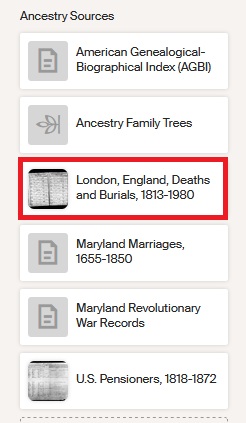
So, definitely check those hints/suggestions to make sure that they match up with what you already know about your ancestor. And, if you don't know much about your ancestor yet, don't add records until you feel confident that you should do so.
Believing family legends
This is a tough one. Sometimes, family stories can be true, but they frequently are not. So, it's a mistake to begin research with the assumption that the stories are accurate.
One of the most common family stories in the United States, especially in families of primarily European-American heritage, is the existence of indigenous American ancestry.
There are lots of other stories that people have been told over the generations. Another common example are stories about name changes occurring at Ellis Island, which are almost always untrue.
Instead of simply taking our family stories at face-value, we should follow the records and see where the journey leads. Start with yourself and work slowly backwards, sourcing as much as you can, and see what truths are revealed.
You might find that the stories are true, or you could learn the truth and make a guess as to how the incorrect story got started.
I once heard a story from a much older first-cousin twice-removed about how my German 3rd great-grandfather left a family behind in Germany. I set off looking for the family and ended up learning that my 3rd great-grandfather's entire family (wife and two daughters) died within a few years of leaving Germany.
He remarried and had my 2nd great-grandfather, who told my cousin the story about his dad's family left behind in Germany. I will never know how or why the incorrect story got started, but I am glad to now know the truth.
Skimping on documentation
Definitely don't just add people to your tree without also adding sources. Ideally, you can add at least several sources for each person in your tree.
Documentation is crucial.
There are many family trees where the creator has only added the names of the people who they believe to be their ancestor, and nothing else.
Some people call this practice "name collecting". It's just collecting names, generation after generation, without performing comprehensive searches for all types of genealogy records that involve the ancestor.
I'm not exactly sure what the goal is for people who build their trees like this, but there are many reasons to not be a name collector.
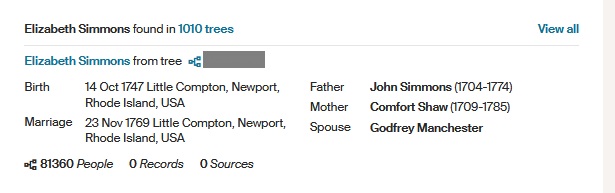
I found a family tree that included my 5th great-grandmother, Elizabeth Simmons, on Ancestry. Unfortunately, the person who made this 81,360-person tree, added Elizabeth Simmons to her tree without including a single source.
And, also unfortunately, the entry for Elizabeth is incorrect, she was never married to Godfrey Manchester.
Not investing enough time or money
Our modern culture has accustomed us to getting a lot of what we need and want quickly, and often times, for free. This is especially true when it comes to information.
When it comes to genealogy research, there are no shortcuts. In order to find the information we need, we may have to pay for subscriptions to records databases, order copies of vital records, and spend many, many (many!) hours researching the same ancestor.
I am the person who tried for years to avoid paying for any subscriptions to do my research. Sure, I was able to make progress, but it was slow.
For my birthday one year, I decided to try out an Ancestry subscription and a separate subscription to Newspapers.com. The results of my research using my new subscriptions amazed me to the point that I felt foolish for not having tried them before.
While there are still many free tools that I use regularly, and I love trying to find ways to get what I need for free, I have now accepted that sometimes it is best to go ahead and pay for subscriptions.
Conclusion
I hope that this post has helped you discover some of the common mistakes that people make when they get started researching their family tree. In fact, even some of the most experienced researchers can make these blunders, too!
If you have any questions about something that you read in this post, if you want to share another common mistake that you think others should know about, or if you want to share your mistake story, I would love to hear from you in the discussion below.
Thanks for being here today!