
Do you want to learn how to find your ancestor on old census records? In this post, learn the steps you should take to get the most from your search efforts.

Census records are one the most useful types of genealogy records. They are objective records that provide a snapshot of our ancestors' lives at regular intervals.
This article primarily addresses finding ancestors in US Federal Census records, which have been collected every ten years since 1790. Some US states also conducted their own censuses, often at different intervals than the federal census.
There are many other countries which have also collected censuses, or a count of their entire population, over the years, and the same basic tips you will find here apply to people searching for their ancestors in those place , too.
Census records are my favorite place to start for genealogy research. I hope that after you read this article, you are able to find your ancestors in old census records, too.
Collect a few key details about your ancestor
Before you start your census search, there are a few bits of information that you should try to collect about your ancestor. You will need as much of this information as possible in order to have the highest chance of finding the right person in your search of census records.
You might be able to find this information by speaking with other relatives, especially those who are older than you, searching online obituaries, or connecting with a relative who has already done a bit of family tree research.
If you don't already know all of this information, don't worry. As long as you know some of these details, you should still be able to find your ancestor.
Full name
If possible, you should know your ancestor's full name. If you know your ancestor's first and last name, this is usually enough.
However, if your ancestor has a very common name (think: John Smith), a middle initial or middle name can also be helpful. It's also good to know if your ancestor had an unusual spelling of their name.
Where your ancestor lived
The second most important detail that you will need to know about your ancestor is the place where they lived. The more details that you know, the better.
For example, it's okay if you only know the state where your ancestor lived. However, if you also know the city or even just the county, that's even better.
The reason that you should try to know the area where your ancestor lived is because there are likely many people with the same or similar name who lived when your ancestor lived. If you do a search with just your ancestor's name, you might receive several pages of results.
Knowing where you ancestor may have lived will help narrow down your search results.
Approximate age
Knowing the approximate age of your ancestor will help you identify which census record was made for your ancestor. There may be several people with similar names to your ancestor living in the same area, and knowing about how old they were will help you eliminate records that belong to other people.
Census takers generally did not write down the exact date of birth of the people that they interviewed for the census. Instead, they often asked their age.
The age that shows up on the census form is the age that the person was when the census was taken, and we can use this information to approximate a year of birth.
Occasionally, census records also asked for month of birth, which can also be helpful to know, if you are able to get this information.
Known family members
If you know the names of anyone who may have been living with your ancestor, this information can be very helpful. For example, if your ancestors' parents or siblings were living with them, this could help you identify the correct record.
As I mentioned earlier in the article, it's okay if you don't know all of this type of information about your ancestor. If you don't know their age or even where they lived, but you know the names of their parents and siblings, you may still be able to find them in the census records.
Decide which online database you will use to search for your ancestor
There are several different options for searching for census records. Many different companies and organizations have made census records available for searching.
Some offer this option for free, and some require you to have a subscription. I have listed a few different places you can try searching below, and I have noted whether they are free or paid sites.
Ancestry
Ancestry is a site that allows people who have registered with a free account to search all records, including census records, for free. You can also currently view the 1880 and 1950 census records for free on Ancestry,
If you are wanting to view the census records for any of the other census years, you would need to have a paid subscription.
I really enjoy using Ancestry and like it for the quality of genealogy records that it offers, and I also build my family tree on the site.
Family Search
Family Search is a completely free website run by the Mormon (LDS) Church. On this site, you can search and view any census record, including many international census records (UK, Mexico, etc) using only a free account.
I really like Family Search for many things, including their genealogy records, and their full-text search capability. However, I don't built my family tree on this site because the tree on the site is a universal tree (no one has their "own" tree) and anyone can edit the tree.
Official 1950 US Census website
If you are interested in playing around with census records just to learn how they work and what information you can find, you might be able to find your parents or grandparents on the government's completely free 1950 US Federal Census page.
Find My Past
Find My Past is a site that allows free searches, but requires a subscription to view the records. This company is based in the UK and so has a more UK focus, which is useful if you are searching for UK census records.
Make sure the records you find are about your ancestor
Once you find a record, the first thing that you should do is take steps to make sure that the records was actually created about your ancestor and not someone with a similar name, age, or family.
It's important to make sure because you will likely base figure research off information that you learn from the census. If you document incorrect information, all of the future research that you do for your family tree may also be incorrect - perhaps leading you to research the wrong people.
Fortunately, there are a few things that we can do to make sure that the census records that we find are actually made about our ancestor and a not different person with the same name.
Check to make sure details match
Make sure that the details from the census record match what you already know about your ancestor. Any inconsistencies may indicate that the census record doesn't belong to your ancestor.
For example, I searched on Ancestry for Thomas Boon, born around 1860 in the 1880 census. There are at least five different people with this name who were born around 1860 in North Carolina.

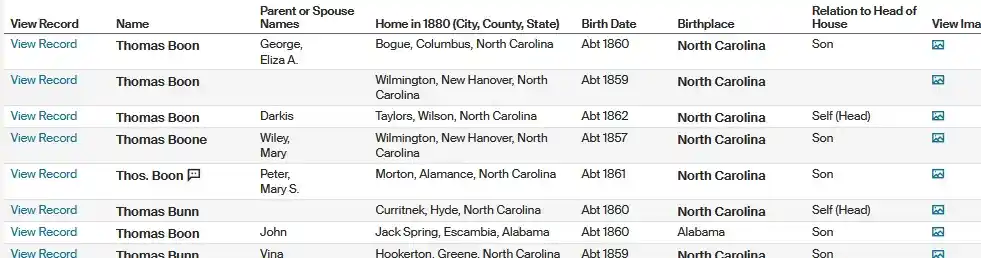
How could I possibly know which one is the Thomas Boon that I really want to find?
Well, if I know that his father's name was George, I could choose the first record to examine more closely. The first record is the only one of the five possible records that lists George as his father's name.
Now, George is a very common name, and I still couldn't be 100% sure that the first record actually belongs to the Thomas Boon that I want to learn about.
When I look at the image itself, I see that it lists his siblings' names. Maybe I know that Thomas had a brother named Miles, and sure enough, there is a Miles listed as a sibling in the actual image.

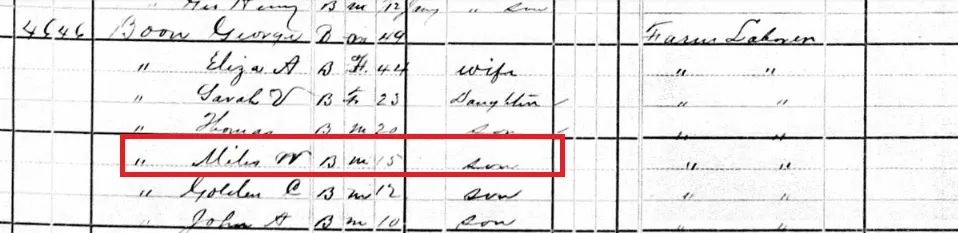
In this example, the name and location match, the approximate age matches, and the names of the family members that I already know also match. This leaves me fairly confident that this census record really does belong to the Thomas Boon that I am searching for.
Find additional records to be sure
Sometimes we don't know enough to be sure about a census record, or the census record doesn't reveal enough information to help us narrow things down. For example, my Irish great-great-great grandfather has a really common name, and he was single during the 1870 census.
When I search for him, I find many different single men with the same name living in the same city popular with Irish immigrants at the time. Since everyone is single, no other family members are listed.
I can't be sure which one is my ancestor, assuming any of them are him. So, I need to search for other types of records to figure it out.
I might be able to find other records that help me learn for sure which neighborhood he was living in at the time (such as city directories) or a record that gives me a more accurate year of birth (future census records or vital records), to name a few examples.
By learning more about my ancestor in other ways, I may be able to find him on the census the next time I look for him.
Conclusion
I hope that this article helped you learn everything that you need to know to find your ancestor in a census record. This can be a great first step to finding out even more information about your ancestor's life.
If you have any questions about something that you read in this post, or if you would like to ask a specific question about locating your ancestor in the census, I would love to hear from you in the discussion below.
Thanks for reading today!