
Did you know that before Ellis Island, most immigrants to the United States arrived at a place called Castle Garden? In this post, learn all about this forgotten part of America's history, and how this place may have shaped your family's journey.

Four of my great-great grandparents arrived at the port of New York during the operation of Castle Garden. Ten of my great-great-great grandparents and eight of my great-great-great-great grandparents were also processed there.
All-in-all, at least twenty-two of my ancestors experienced Castle Garden as their first impression of the United States of America. They came from five different countries: Poland, the United Kingdom, the Netherlands, Germany, and Ireland.
Experts estimate that about 20% of Americans can trace their ancestry back to at least one ancestor who came through Castle Garden as part of their journey to the United States. There is a good chance that you, too, have ancestors who saw Castle Garden.
What did our ancestors see when they first arrived? What was the process like for them at Castle Garden, and where did they go once they left?
These are just some of the many questions that I answer below.
What was Castle Garden?
Castle Garden is an old fort that was built in 1811 on a small artificial island 200 feet off the southernmost tip of Manhattan, New York City. The fort eventually became Castle Garden, an immigration station.
The fort, which was named Fort Clinton, was originally planned as a military defense installation, but it was never used for this purpose.
The original thought behind what we now know as Castle Garden was to built a fort to protect the New York City area from the British. Around the time of the building's construction, the US anticipated eventual conflict with the British, which did happen in the War of 1812.
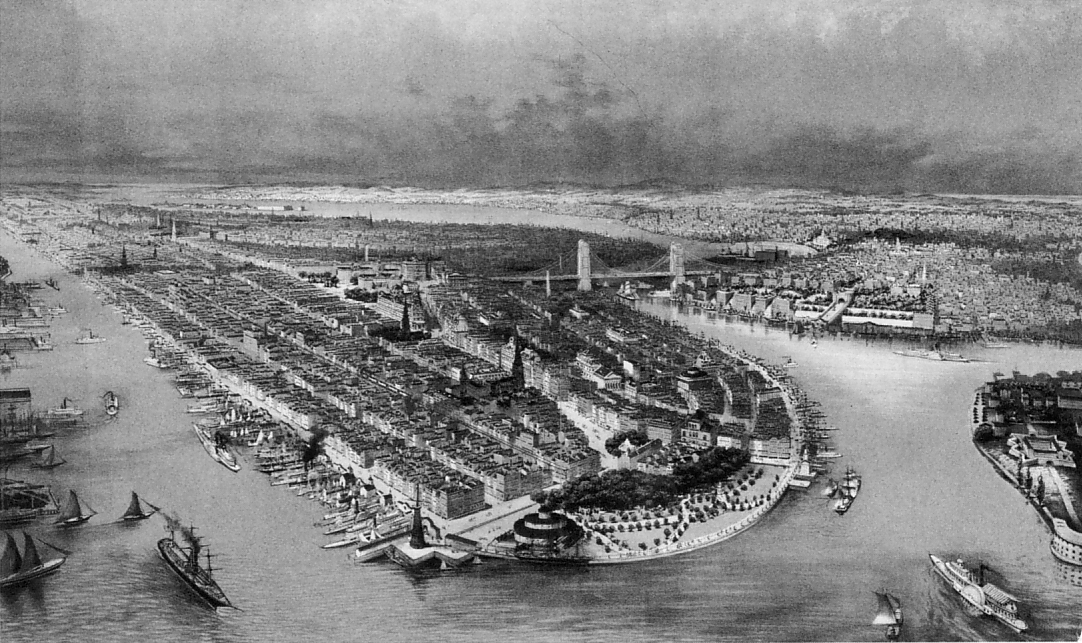
However, the War of 1812 was relatively short, with major battles happening away from the NYC harbor. Fort Clinton ended up only being used for administration and storage.
For a few decades, the building was leased to New York City and was used as an entertainment venue and theater. Finally, in August of 1855, the site began processing immigrants to the US as the Emigrant Landing Depot.
Castle Garden was finally an immigration station from August, 1855 to April, 1890. During this time, more than 8 million immigrants from many different countries were processed at the Castle Garden immigration station.
What was the immigration process like?
The first step in the immigration process at Castle Garden was for a ship to anchor in the harbor and wait for an immigration official to board the boat. This was just a basic inspection, during which time the officials could designate immigrants as unfit for entry into the US based on any criteria, such as illness or being "undesirable".
Most immigrants were allowed to board the barges that would take them to the docks at Castle Garden. Then, they could enter the rotunda to be processed.
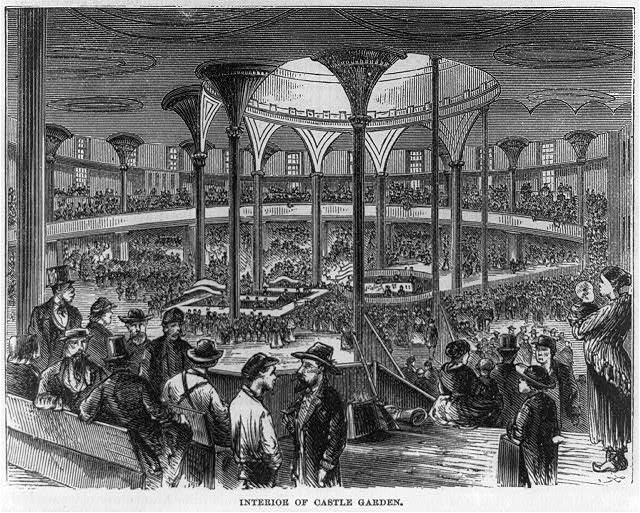
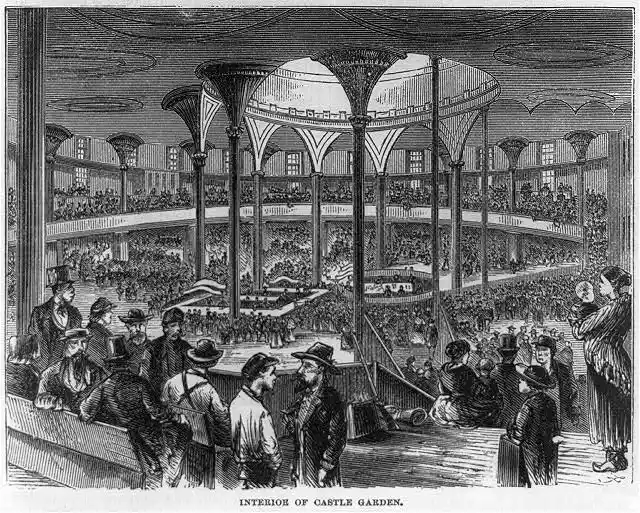
People often described the rotunda as a very noisy place, filled with people speaking different languages. One immigrant succinctly expressed the sensation that many people likely felt upon entering: there was a lot to hear and little to understand!
As a first step, all immigrants were required to take a bath. They were provided with soap, water and towels in order to clean up after their long ocean journey.
Immigrants were then typically formed into two lines, one for English-speaking migrants and the other line for those who spoke other languages. Once they got to the front of the line, they were asked several questions about themselves and their plans in the United States.
Some typical questions were about how much money the immigrant had, who had paid for their passage, and who had encouraged them to come to America, among others. During this short interview, the officer could decide that the immigrant was unfit for entry.
After the interview, immigrants had to stand in a different line to see a doctor. The doctor's visits were short, with the goal of making sure that potential immigrants were not carrying obvious diseases and that they were healthy enough to work.
Finally, if all went well, an immigrant could have purchased a meal. One such meal was described as sausage, bread and coffee. After eating, they might have gone to exchange what foreign currency they possess for US dollars.
Every immigrant had to leave Castle Garden by the end of the day. There are many stories of people taking advantage of these new immigrants outside the doors of the immigration station, trying to get what little money they may have had.
It's hard to imagine how scary and overwhelming it must have been for our ancestors to come to a new, strange land where they didn't understand the language that was spoken. Most of our ancestors had few friends or relatives in the US, and some of them had no one to help them at all.
They were truly starting over from scratch in a totally new place.
Where did immigrants go after they left Castle Garden?
After immigrants were finished with the inspections at the immigration station, they were free to leave. There were multiple train companies that sold tickets at the Railroad Office located at Castle Garden.
If they weren't leaving on a train, the immigrants were free to simply walk out of Castle Garden's doors and into Battery Park. Some even chose to linger at the park, no doubt enjoying the scenery and imagining what their new lives in America would bring.
Many immigrants at Castle Garden were able to find jobs in New York City and the surrounding areas through the Labor Exchange office that was located in a small building near the immigration station.
Immigrants from Castle Garden ended up in every state across the country, with some even going to Canada. Once they left Castle Garden, there was no limit on where they could go, as long as they could afford the transportation to get there.
As I mentioned towards the beginning of this article, at least 22 of my ancestors were processed at the Castle Garden immigration station. Of these ancestors, two remained in New York City, two went to farms in Illinois, four went to live in Chicago, and the rest traveled the short distance to Newark, New Jersey.
Immigrants often chose a place to live based on family connections that were already there. They also may have moved to an area if there was already an established community of immigrants from their country already living there, especially if they spoke languages other than English, in order to have a support system during their first few years in the US.
Of my 22 ancestors who came to the US through Castle Garden, only three were English-speakers upon arrival. One stayed in Newark for a few years, but eventually moved to southern New Jersey to be a farmer, while the other two immediately began farming in rural Illinois.
All of my German, Polish, and Dutch-speaking ancestors chose to live in Chicago and Newark in neighborhoods where there were lots of other people who spoke the same language.
Army recruitment
During the Civil War, there was a US Army recruitment office located immediately next to Castle Garden. New immigrants were encouraged to join the military, and this opportunity may have helped them acquire citizenship or earn money.
About one-third of enlisted Union soldiers were foreign born. This is significant when you consider that when the Civil War started, only about 13% of people in the US were foreign-born.
The US government even made attempts to recruit soldiers for the Union side in other countries, which means that some immigrants may have come to Castle Garden with the specific goal of joining the army.
Why did they stop using Castle Garden for immigration?
There were a few reasons that Castle Garden closed in 1890 and was no longer used for processing immigrants. Immigration numbers were growing in the late 1880s, and Castle Garden was crowded, run-down, and riddled with corruption.
Along with the boom in immigration of the 1890s, Manhattan was also experiencing significant economic growth. Today, we call this period of time "the Gilded Age", and it was most visible in New York City's elite.
Having a more organized, effective way of processing a large number of poor immigrants away from Manhattan's shores could possibly have been a factor in deciding to relocate the facilities. Anti-immigrant sentiment was at least indirectly the cause of Castle Garden's closure, since there was great pressure on the federal government to monitor and limit the flow of immigrants during this time period.
The decision to close the Castle Garden immigrant processing site was made by the federal government. In 1981, the government took over the responsibility for admitting immigrants to the US and decided to use Ellis Island as a new processing site.
Where are Castle Garden immigration records held?
If you believe that you have ancestors who were processed at the immigration station at Castle Garden, you will be happy to know that you may be able to find their immigration records online.
Family Search has a database that you can search for free. If you have a subscription, you can also find these records on Ancestry.com.
After Castle Garden closed, its records were moved to Ellis Island. There was a fire at Ellis Island in June, 1897 that destroyed many Castle Garden records, but many still exist.
I have been able to locate immigration records online for almost all of my 22 ancestors who came through Castle Garden.
Does Castle Garden still exist?
Castle Garden still exists today, but it is now part of Manhattan's Battery Park, and is no longer on an island separate from Manhattan. In 1869, the island was expanded artificially using landfill to connect with Manhattan.
After the closure of the immigration processing center in Castle Garden, the building was modified and used for several decades as an aquarium. Once the operators of the aquarium decided to cease using the Castle Garden site, some people wanted to preserve Castle Garden, or Fort Clinton.
A vocal opponent of preserving Castle Garden was Robert Moses, a well-known, influential New York politician. In 1941, he announced that Castle Garden would be demolished, dismissing its historical significance.
Eventually, the movement to preserve the Castle Garden or Fort Clinton gained momentum, with congress passing a law designating the location as a US national monument in 1946.
In the early 1950s, the city government ceded the site to the federal government, which began the process of restoring and preserving the building and its history.
Today, you can visit the restored Castle Garden to buy tickets to visit the Statue of Liberty. More than three million people each year visit this national monument, which speaks to its significance as a part of our country's history.
Conclusion
I hope that you have enjoyed this article and that you have learned all you wanted to know about how Castle Garden was used for immigration purposes during the 1800s.
If you have any questions about something that you read in this article, or if you would like to share a story about a relative who passed through Castle Garden, I would love to hear from you in the discussion below.
Thanks for reading today!
Susan Sachs
Wednesday 17th of December 2025
Where did immigrants land when the fire of 1897 closed Ellis Island?
Mercedes
Sunday 21st of December 2025
Hi Susan, They were processed at the Old Barge Office in Manhattan until the Ellis Island office could reopen. Excellent question!