
Have you seen your ancestor's occupation on a census record? In this post, learn what the most common jobs were, and what your ancestor's job can reveal about their life.
Census records are one of my favorite types of genealogy records. On these records, you are likely to discover the type of job that your ancestor had.
Different jobs required specific skills, language abilities, and education. Similar to how things work in modern times, the kind of job that your ancestor had can reveal a lot about their background and social status.
I have discovered all sorts of occupations for my ancestors on census records: janitor in a church, saloon keeper, fireman in a boiler room, civil engineer, farmer, midwife, barber, washer, and many others. My ancestors performed a variety of work in order to pay the bills and feed their families.
Some of my ancestors' jobs were common, and others were more unusual.
What were the most common jobs?
The type of work most commonly found on any given census record is going to depend greatly on the year the census was given and the place that was surveyed.
As an example, take the 1880 US Federal Census where 17 million people reported having an occupation. Below are the ten most common types of occupations reported for this census year.
- Farmers (about 4.2 million)
- Farm laborers (3.3 million)
- General laborer (1.8 million)
- Domestic servant (1 million)
- Store or shop clerk (353,000)
- Teachers and "scientific persons" (227,000, with 154,000 being female, so likely primarily teachers)
- Laundresses (108,000)
- Physicians and surgeons (85,000)
- Hotel and restaurant employees (77,000)
- Government officials (67,000)
If you were to look through several pages of a census form for Newark, New Jersey, you would see more store clerks, domestic servants, and people working in factories. A census record for the same year for a rural Illinois county might reveal more farmers and farm laborers, with fewer or no factory workers.
In 1880, 41% of those employed reported that they work in agriculture. This number was lower than the about 50% reported in the 1870 census.
Over the course of the 140 years since the 1880 census, the number of people working in agriculture has continued to decline, with the most recent statistics showing that only about 1.3% of people in the United States are employed in this industry. When we consider which occupations are most common in the census, we will expect to see more people working in other fields in the more recent census reports.
Some other common occupations for other census years include:
- Clerk (like in an office)
- Seamstress
- Carpenter
- Blacksmith
- Mason
If you were to look at a census page, you might see a dozen or so different occupations on just that single page. In reality, there are hundreds, if not thousands, of specific jobs that your ancestors could have had. Since this article focuses only on the most common, we will dig deeper into some of these individual occupations.
Regardless of whether your ancestors had any of these common jobs, I would encourage you to keep reading to see what kind of clues you may be able to find in your ancestors' occupations.
What each occupation can reveal
Below, we will dive into what the professions I have mentioned so far might reveal about your ancestor, what conclusions you could come to, and how to find out more.
Farmer vs. farm laborer
If your ancestor was listed as a farmer, it might mean that he owned his own farm. If he was a farm laborer, it most likely meant that he worked on someone else's farm.
This information can help you understand their social standing where they lived, a bit about their financial stability, and whether they may have passed land down to their children. You might also see children of farmers go into farming themselves, so it could be a useful clue about the next generation.
Your ancestor's occupation, and that of their neighbors, can also help give you insight into the type of community where they lived. As an example, I pulled up the 1880 US Census from a rural Illinois county.
All of the heads of household on this page of the census are listed as "farmers", and they all have wives who stayed at home. In addition, there are no farm hands, boarders, or unrelated men with "farm laborer" as their occupation.
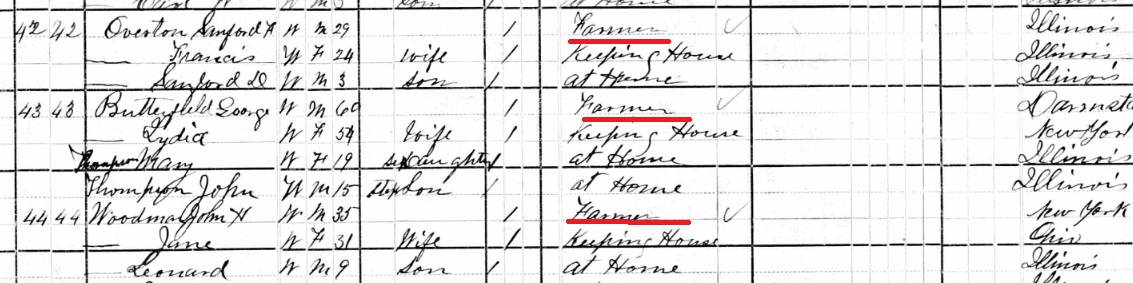
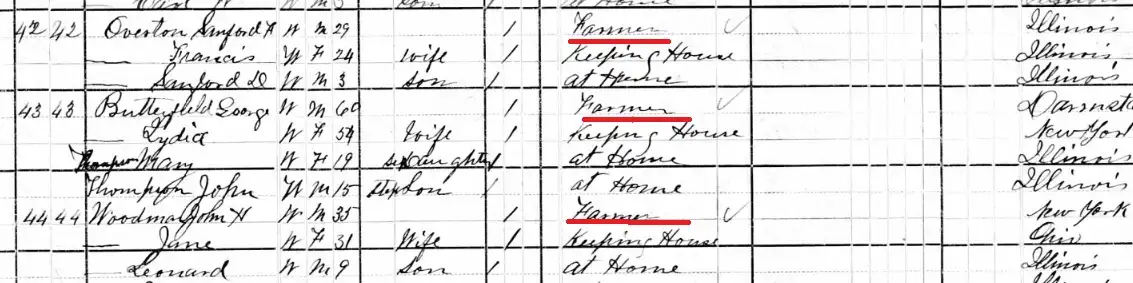
One conclusion that you could come to after looking at a census record like this is that this was not a wealthy farming community. Everyone who lived there likely had a small plot of land that they farmed, and they didn't need additional help on their farm.
If you discover that your ancestor was a farmer, and not a farm employee, you might be able to learn more about their farming endeavors. You could consult earlier census records, such as the 1860 US Census, to find the value of their real estate.
You could look for homestead records to see whether they purchased land and how many acres, or you could check military pension records to see if they were granted land as a veteran's benefit.
Sometimes old maps specific to the county where your ancestor lived are a good source of information about who owned which farming plots.
It's also possible that you could find more information on US IRS tax assessment lists, though I have noticed that the tendency to underestimate one's property and earnings for tax purposes is not a new phenomenon.
General laborer
I find that the "general laborer", often listed as just "laborer" on the census, is a very interesting occupation. A general laborer might have been available for any kind of work that they could find.
To be a laborer generally didn't require any special skill or education, so it likely didn't pay especially well. In my family tree, I often found my ancestors who had recently immigrated to the United States working as "laborers".
These jobs also may not have been regular jobs, and likely didn't offer the same level of financial stability as other jobs.
Occasionally, an ancestor who was young and just getting established in their career would be a laborer. Over time, they might gain the skills and experience to get a new, more specific job title.
When I find an ancestor who was working as a laborer, I like to see how their career evolves over time. With my immigrant ancestors specifically, I assume that their career prospects improve along with their English-language skills.
Servant vs. keeping house
Many of us might have had female ancestors who worked as a servant and others who had their occupation listed as "keeping house". While these two occupations might have similar job responsibilities, there are major differences between the two.
Women who worked at "keeping house" typically did so at their own house, which means that they were not paid for their work. Servants, on the other hand, were paid a salary, however small, for their labor.
You might assume that the servant had the higher social standing because they earned money. While having more money is good for social standing, women generally worked outside the home only when they absolutely needed to.
Thus, a family with a wife who was employed as a servant generally had a lower social standing than a family with a mother/wife who stayed at home and tended to her own house. Poorer families also commonly sent their daughters off to work as servants for wealthier families.
With this said, it was very common for women to do a lot of work "under the table", or unofficially, to earn extra money to help provide for the family.
My great-grandmother was a servant for a wealthy family in New Jersey, though the family stories about this weren't exactly true. I grew up with stories about how she worked as a cook in the governor's mansion, but this is not what I found once I started to do the research.
If you find that your ancestor is living at someone's house while working as a servant, you could do a bit of research about the family that she works for in order to learn more about what her life might have been like while she was working in their household.
Clerk
If you had an ancestor who worked as a clerk, whether in an office or a store, it might indicate that your ancestor was literate and perhaps educated. Clerks often had to handle money, write letters, or even handle accounting.
Clerks are just one occupation that is evidence of a rising middle class.
If you have an ancestor who worked as a clerk, you might be able to find additional employment records for them. Old newspapers also could be a good source of information for ancestors who held jobs like clerks.
Teacher
Since most census records listing occupation were created during the second part of the 19th century, we can assume that most of our ancestors who had the occupation of teacher were women.
Teaching was generally considered a job for women, but only single women. Thus, if you have an ancestor who was a teacher on a census form, they were likely single.
Teachers were also fairly well-educated. To be a teacher, the woman usually needed to have finished high school and a teacher training program, sometimes called a normal school.
It would have been expensive to continue to maintain and support a daughter through a high school education and fund her studies at a normal school. This could mean that if your ancestor was a teacher, her parents were more well-off than some.
Laundress or launderer
Our ancestors who were laundresses were hard workers, but they were almost never wealthy. If you have an ancestor who was a laundress, she likely did this job because she had few other options.
I have an ancestor, Julia, who was born in Germany in 1810. By 1860, she was living in the United States with her young son, Frederick.
I don't know what happened to her husband, Frederick's father, but I assume that he died. One of the only things that I do know about Julia is that she worked as a laundress while Frederick was a boy.
Since Julia never remarried, she had no other choice but to wash other people's laundry. As a woman, and a person who probably only spoke German, she had no other choice in order to feed her son and provide a roof over his head.
While I feel sad for Julia, there is a part of the story that warms my heart. By the 1870 US Census, Frederick is 22 years old and his mother's occupation is listed as "keeping house" that year.
I like to imagine that Frederick started working as soon as he could so that his mother could stop doing laundry for a living. Frederick's job in 1880? A huckster.
If your ancestor was a laundress like mine was, you can view her work in the broader context of her family story. Questions like why she was doing this work, and what her personal circumstances may have been, are a good place to start.
Trades-person (Blacksmith, Carpenter, Mason, etc)
Skilled trades like carpenter, blacksmith, mason, and others are a special group of occupations. While these occupations were usually learned through an apprenticeship arrangement, they also may have been trades that were passed down from father to son.
While these trades usually didn't require academic training, such as a college degree, there was a great degree of skill needed to perform good work. This meant that these jobs were coveted and the work was fairly compensated.
A skilled tradesmen could become very well-off as his career progressed, especially if he was good with managing money. I noticed an example of this today, while researching for this article.
On one census for a farming community I found, the wealthiest farmer had real estate worth about $4000, while most of the other farmers had farms only worth about $500-800. The second wealthiest person in the community? A carpenter, with real estate valued at $3000.
Sometimes you can see how trades are passed down and evolve in families over the generations.
For example, the father of my Dutch immigrant ancestor was a carpenter, and so was his son. I have read in old letters that he did beautiful carpentry work in grand buildings in the Netherlands. Both my great-grandfather and my grandfather became engineers, most likely because they grew up around a culture of building things.
Conclusion
I hope that you enjoyed this article and that it helped you understand more about what your ancestor's occupation can reveal about their life, as well as their economic and social standing in their community.
If you have any questions about something that you read in this post, or if you would like to share a story about your ancestor's occupation that you found on a census record, I would love to hear from you in the discussion below.
Thanks for reading today!